
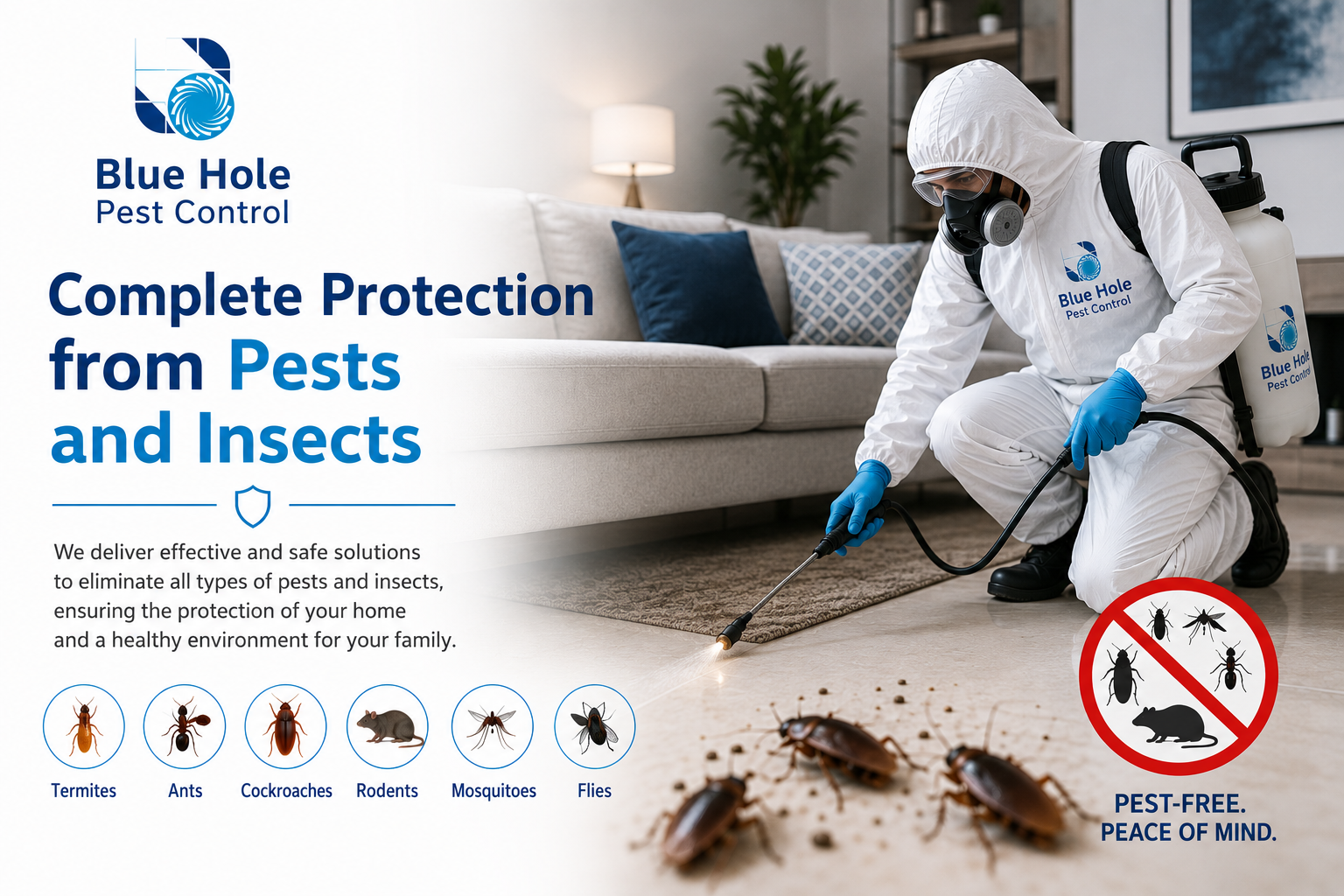
A Comprehensive Guide to Pest Control and Pest Management: From Inspection to Prevention
The presence of insects or rodents in a home or facility does not necessarily mean that the problem is limited to the pests you can see. In many cases, visible pest activity is the result of underlying factors such as entry points, food and water sources, hiding places, or environmental conditions that support breeding.
For this reason, professional pest management begins with understanding the problem, identifying the type of pest and the source of its activity, and then selecting the most appropriate method of control.
At Blue Hole, we approach pest management as an integrated process that begins with inspection and assessment, followed by treatment and monitoring, and concludes with preventive measures designed to reduce the likelihood of the problem recurring.
What Is Professional Pest Management?
Pest management does not simply mean applying pesticides as soon as an insect is spotted.
A professional approach begins by answering several essential questions: What type of pest is present? Where is it entering from? Where is it hiding or breeding? What conditions are allowing the activity to continue?
Based on the inspection findings, an appropriate pest management plan is developed for each case rather than relying on a single method for every type of infestation.
This is the foundation of Integrated Pest Management (IPM).
Integrated Pest Management (IPM)
Integrated Pest Management combines multiple measures to control pest problems while addressing the factors that contribute to their presence.
The IPM approach is based on five key areas:
1. Pest Exclusion
The first step is to identify the routes insects and rodents may use to enter the building.
This may include inspecting cracks and gaps, areas around doors and windows, utility openings, pipes, and other potential entry points.
Addressing these areas helps reduce opportunities for pests to enter the property instead of dealing with them only after they have already gained access.
2. Environmental Modification
Pests generally need food, water, and shelter to survive and reproduce.
For this reason, the property is assessed for conditions that may support pest activity, such as moisture, water leaks, accumulated waste, or unused areas that provide suitable shelter.
Reducing these factors is an important part of an effective pest management plan.
3. Sanitation
Sanitation is a fundamental part of pest management programs, particularly in kitchens, restaurants, warehouses, and food storage areas.
Removing food residue and waste, maintaining clean storage areas, and managing garbage properly can help reduce the food sources and attractants available to insects and rodents.
4. Physical Control
Some situations may require physical control methods such as traps, monitoring devices, barriers, and other tools appropriate to the type of pest and the property.
These methods can also help monitor pest activity and identify areas that require additional attention.
5. Targeted Chemical Control
When chemical treatments are required, the appropriate method is selected according to the type of pest, the level of infestation, and the location of the activity.
The objective is to use treatment in a targeted and controlled manner as part of the overall pest management program, rather than relying on indiscriminate spraying as the only solution.
What Types of Pests Require Professional Control?
Each type of pest has different behaviors and characteristics, which means that detection and control methods also vary.
Some of the most common pests found in homes and commercial facilities include:
Cockroaches
Cockroaches generally prefer areas where food, moisture, and shelter are readily available. For this reason, they are commonly found in kitchens, bathrooms, drainage areas, and storage spaces.
Effective treatment begins by identifying hiding areas, pest activity, and food and water sources before selecting the appropriate control program.
Ants
Seeing a small number of ants may indicate the presence of a much larger colony elsewhere.
Therefore, effective control is not limited to eliminating visible ants. It also involves identifying their movement trails, food sources, and potential nesting locations.
Bed Bugs
Bed bugs require careful inspection because of their ability to hide in cracks, joints, and areas surrounding sleeping spaces.
Inspection may include mattresses, bed frames, furniture, and nearby areas to determine the extent of activity before selecting an appropriate treatment method.
Mosquitoes
Mosquito problems are often associated with water sources and nearby breeding areas.
A pest management plan should therefore include identifying these sources and reducing the conditions that encourage mosquito breeding, along with applying appropriate control measures.
Flies
Persistent fly activity may indicate the presence of an attraction or breeding source that needs to be addressed.
Identifying the source, improving sanitation, and managing waste properly are essential parts of controlling the problem.
Rodents
Rodent management requires identifying movement routes, entry points, food and water sources, and hiding places.
Appropriate monitoring and control measures can then be implemented while addressing the conditions that allow rodent activity to continue.
Termites
Termites differ from many other pests because they can affect wooden elements and buildings without obvious signs of activity during the early stages.
Managing termites requires a specialized inspection to identify the type, location, and extent of the infestation before determining the appropriate treatment program.
How Does Professional Pest Management Work?
Under the professional approach followed by Blue Hole, pest management consists of several interconnected stages:
Inspection → Pest Identification → Assessment → Pest Management Plan → Implementation → Monitoring → Reporting → Improvement
Stage 1: Site Inspection
The process begins with an inspection of the property to identify signs of pest activity, potential entry points, hiding places, food and water sources, and environmental factors associated with the problem.
Stage 2: Pest Identification
Correctly identifying the pest is an essential step because each species has different behavior and life cycles, which means the management strategy must also differ.
Stage 3: Assessing the Level of Infestation
Once the pest has been identified, the extent of the activity, affected areas, and conditions contributing to the problem are evaluated.
Stage 4: Developing a Pest Management Plan
Based on the inspection and assessment findings, appropriate measures are selected for the specific situation. These may combine preventive measures, physical controls, targeted treatments, and other suitable procedures.
Stage 5: Implementation
The pest management plan is implemented in the targeted areas according to the type of property, the pest involved, and the level of activity.
Stage 6: Monitoring and Follow-Up
Professional pest management does not necessarily end once treatment has been applied.
Follow-up helps evaluate the results, detect any new activity, and determine whether additional measures are required.
Stage 7: Reporting and Improvement
Particularly in commercial facilities, reporting helps document pest activity, completed procedures, observations, recommendations, and any required corrective actions.
This transforms pest control from a temporary response into an ongoing management and monitoring program.
Pest Management for Commercial Facilities
Commercial facilities require a different level of pest management because pest activity can affect operations, hygiene, products, and the customer experience.
Professional pest management programs can be suitable for sectors such as:
- Restaurants and food establishments
- Hotels and hospitality facilities
- Warehouses and storage facilities
- Factories and industrial facilities
- Offices and commercial properties
- Healthcare facilities
- Educational facilities
- Residential complexes and buildings
In these environments, monitoring, documentation, and preventive measures become essential parts of the pest management program rather than simply applying treatment when a problem appears.
Pest Control for Homes and Villas
In homes, pest activity may begin in areas such as kitchens, bathrooms, gardens, or storage spaces and then spread if the underlying cause is not addressed.
A professional inspection helps identify the areas with the highest activity and the factors attracting pests before selecting a solution appropriate to the property and the way different spaces are used.
Preventive measures following treatment can also help reduce the likelihood of the problem recurring.
Prevention Is Better Than Waiting for an Infestation
One of the primary objectives of professional pest management is to move from reactive treatment to proactive prevention.
Measures that can help reduce the likelihood of pest activity include:
- Sealing cracks and potential entry points.
- Addressing moisture and water leaks.
- Storing food properly.
- Disposing of waste regularly.
- Keeping storage areas clean.
- Reducing clutter and potential hiding places.
- Monitoring areas where pest activity has previously occurred.
- Conducting periodic inspections in locations that may be vulnerable to infestation.
Why Choose Blue Hole for Pest Management?
At Blue Hole, our approach is not limited to eliminating the pest that is currently visible. We aim to understand why it appeared, where it came from, what is allowing it to survive, and how the likelihood of its return can be reduced.
Our approach therefore focuses on inspection, pest identification, activity assessment, appropriate planning, targeted treatment, monitoring, follow-up, and preventive measures.
We provide pest control and pest management solutions for homes, villas, commercial properties, and other facilities across Al Khobar, Dammam, Dhahran, Qatif, Jubail, Al Ahsa, and surrounding areas.
Start with Inspection, Not Spraying
The presence of insects or rodents is a sign of a problem, but eliminating only what you can see may not eliminate the source.
Effective pest management begins with proper inspection, understanding pest behavior, identifying the source of activity, applying the appropriate solution, and monitoring the results.
If you notice insect or rodent activity in your home or facility, contact Blue Hole to request a site inspection and determine the appropriate pest management program.