
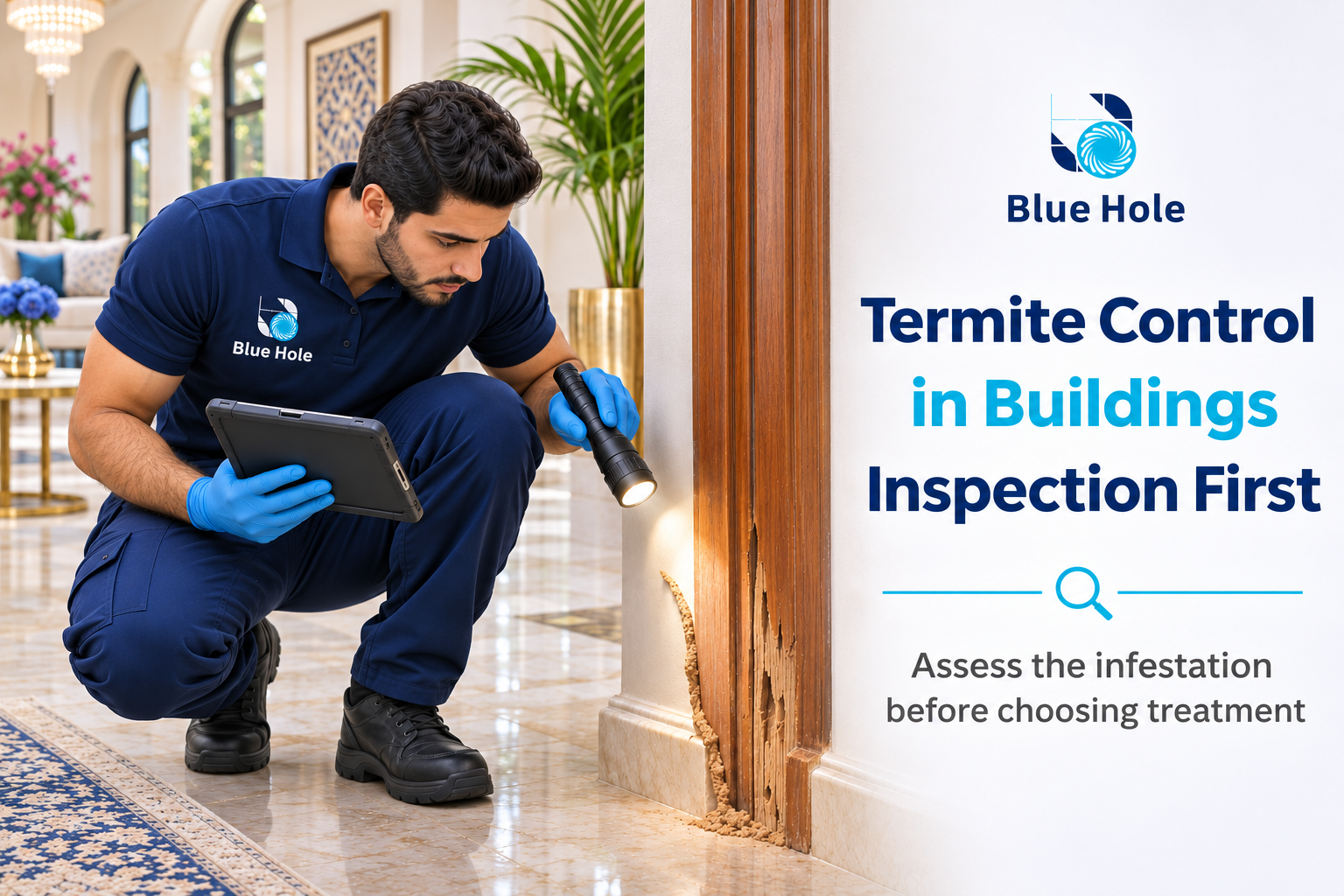
Termite Control in Buildings: Why Inspection and Infestation Assessment Matter Before Treatment
The first sign of termites may be a small mark beside a door frame, a mud tube on a wall, or unexpected damage to a wooden fixture. However, what you can see does not necessarily reveal the source or full extent of the problem.
Effective termite control in buildings begins with inspection, identification, and an assessment of the affected areas. Treating a visible sign alone may leave other parts of the infestation unexamined.
This guide explains which signs warrant an inspection, how assessing the property helps define the treatment scope, and which questions to ask before agreeing to a termite management programme.
Why Is a Termite Inspection Necessary Before Treatment?
A termite inspection helps establish whether an infestation is present, identify visible activity and contributing conditions, and assess accessible areas before a treatment and monitoring plan is developed.
An inspection is more than a step towards obtaining a price. It helps clarify which areas need treatment, which require further investigation, and whether maintenance work is also necessary.
The assessment should address questions such as:
- Are the observed signs actually caused by termites?
- Where has evidence been found, and are there signs elsewhere?
- Which wooden materials or building components are affected?
- Are moisture, leaks, or other conditions contributing to the problem?
- Are any concealed or obstructed areas inaccessible for inspection?
- What treatment scope is proposed, and how will its effectiveness be reviewed?
Explore Blue Hole’s termite control service to request an assessment suited to your property.
What Are Termites, and Why Can They Be Difficult to Detect?
Termites are insects that feed on cellulose-containing materials, including wood. Their habits vary by type: some are associated with soil, while others can establish themselves within timber.
Activity may occur in concealed areas. Looking at the surface of a wooden fixture or a finished wall is therefore not always enough to determine the property’s condition.
Likewise, seeing winged insects near a home does not automatically confirm a building infestation. The insects need to be identified, and the site inspected, before drawing conclusions.
What Are the Signs of Termites in Buildings?
Several signs warrant attention and a professional inspection. On their own, however, they do not establish the extent of an infestation or the correct treatment.
1. Mud Tubes and Earthen Trails
Mud tubes may appear on foundations, walls, or near areas where the building meets the ground. These structures are associated with certain subterranean termites.
Take a clear photograph, record the location, and note when you first noticed the tube so the inspector can review it during the visit.
2. Winged Insects or Discarded Wings
Winged insects appearing indoors, or discarded wings accumulating near windows, should prompt identification and investigation.
Insects that entered from outside may have a different significance from insects observed emerging from within the building. Tell the inspector exactly where and how they appeared.
3. Damaged or Hollowed Wood
Damage to a door frame or another wooden component may require examination to determine its cause.
Not all wood damage is caused by termites. Moisture, other pests, and deterioration of the material can also be responsible.
4. Similar Signs in Several Locations
If similar signs appear in different rooms, document each location.
This does not automatically mean the entire building is infested, but it is a reason to assess a wider area rather than focus only on the first visible sign.
What Is the Difference Between Termites and Ants?
Winged termites and flying ants can be confused. As a general identification clue, termite wings are approximately equal in length, and their antennae are relatively straight. Flying ants have longer front wings than hind wings and bent antennae.
An unclear photograph or a familiar name for the insect is not always enough for reliable identification.
If the inspection establishes that the problem involves ants rather than termites, the management approach will differ. Learn more about the relevant service on Blue Hole’s ant control page.
What Does Assessing the Extent of an Infestation Mean?
Assessing the extent of an infestation means documenting where evidence has been found, which areas have been inspected, and which locations still require investigation, then using those findings to define the work.
A useful report should distinguish between the following situations:
| Finding | What Should Be Explained |
|---|---|
| Confirmed activity | The evidence supporting the assessment and its location |
| Signs or damage requiring interpretation | Whether the cause has been established or further investigation is needed |
| Suspected area | The reason for concern and the next step for verification |
| Inaccessible area | Why it could not be inspected and what is needed to gain access |
| Contributing conditions | Relevant observations about moisture, storage, or access to wood |
These distinctions help separate confirmed findings from unresolved questions.
A sign beside one door is not, by itself, enough to justify treating the entire building. Equally, finding no signs in one room does not establish that every concealed area is free of termites.
How Should You Prepare for a Termite Inspection?
Clear background information helps direct the inspection towards the areas of concern.
Before the visit, prepare:
- Photographs of the signs, with each room or location identified.
- The date you first noticed them and any subsequent changes.
- Information about leaks, renovations, or repairs.
- Previous treatment reports, if available.
- A list of areas that are difficult to access.
- Details of how the building is used and when it is available for inspection.
Avoid relying only on a general description such as “there are insects in the house.” Explain whether you have seen live insects, discarded wings, mud tubes, or damaged wood.
What Does a Professional Building Inspection Include?
An inspection may cover accessible internal and external areas, vulnerable wooden components, water sources, and conditions associated with termite activity.
Its limitations should be clearly recorded, particularly where furniture, finishes, or access restrictions prevent an area from being examined.
It is also important to distinguish a pest inspection from a structural safety assessment. If there are concerns about the safety of a building component, request an evaluation from an appropriately qualified specialist. A pest control report should not be treated as a substitute.
What Are the Options for Termite Treatment?
No single method is appropriate for every building. The choice depends on the termite type, infestation characteristics, property design, and access to treatment areas.
Blue Hole’s termite service lists options including soil treatment, localised applications, baiting systems, wood treatment, and preventive barriers, selected according to site requirements.
Soil Treatment
Soil treatment may be considered in cases involving subterranean termites. Selecting this approach requires an assessment of the relationship between the soil and the building, along with the practical requirements of the site.
Localised Treatment and Wood Treatment
These options may be appropriate for particular locations, depending on the findings.
However, limiting treatment to a visible area should be supported by an assessment explaining why that scope is suitable.
Baiting and Monitoring Systems
Baiting systems are used in some termite management programmes and require follow-up according to the selected system.
Understand the inspection schedule and associated responsibilities. Installing a system should not be viewed as the end of the process.
Preventive Barriers and Measures
Preventive options may be considered according to the construction stage and property condition.
The proposal should clearly distinguish preventive work from treatment intended to address an existing infestation.
Product selection, application methods, and treatment locations should be determined by the professional, in accordance with product instructions and site requirements.
What Is the Difference Between Pre-Construction and Post-Construction Termite Control?
The timing of the work affects planning and access to treatment areas.
| Aspect | Before or During Construction | After Construction |
|---|---|---|
| Main purpose | Plan preventive measures during relevant construction stages | Assess the existing condition and establish the required work |
| Access | Depends on the construction stage | May be restricted by finishes and occupancy |
| Coordination | With the contractor and project supervisor | With the owner or facility management |
| Documentation | The scope and stages of the work performed | Inspection findings, treatment areas, and access limitations |
If you are building a new property, discuss termite prevention early with the parties responsible for the project.
For an occupied building, ask how the proposed work may affect daily activities and existing finishes before treatment begins.
Why Is Removing Visible Termites Not Enough?
Removing the winged insects you can see does not necessarily address the source from which they emerged.
Similarly, the immediate disappearance of visible signs is not, on its own, proof that the problem has been resolved. There should be a clear way to assess the outcome and monitor the site.
Instead of asking only, “Will the area be sprayed?”, ask:
- What did the inspection confirm?
- How does the proposed plan address the source of activity?
- Which areas will be treated?
- How will the results be monitored?
- What happens if new signs appear?
What Should a Termite Control Proposal Include?
Request a clear proposal that you can review and compare. Where applicable, it should describe:
- The property and the observed problem.
- The inspection findings and limitations.
- The treatment scope and included areas.
- The proposed method and why it was selected.
- Preparations required before the work.
- Instructions for using the property after treatment.
- The follow-up schedule, if included.
- Any warranty terms and exclusions.
Ask specifically whether the agreement covers retreatment, damage repairs, or both. These are different commitments, and one should not be assumed from the other.
What Determines the Cost of Termite Control?
A meaningful quotation requires a clear understanding of the work to be performed.
Ask for the quotation to explain relevant cost factors, such as:
- The areas included in the inspection and treatment.
- The building layout and accessibility of the work locations.
- The proposed control method.
- Any follow-up visits.
- Preparatory work or coordination with other contractors.
- Additional or excluded tasks.
Compare quotations by scope, documentation, and follow-up arrangements as well as price. Differences in cost may reflect differences in what the service includes.
How Can Prevention Help Reduce the Risk of Infestation?
Useful preventive measures include repairing leaks, improving drainage around the property, avoiding the storage of timber debris against the building, and reviewing potential entry points.
Periodic inspections can also help identify signs and conditions requiring attention. The appropriate monitoring schedule depends on the property and the service programme.
These measures support prevention, but they do not replace professional assessment when signs of an infestation are present.
Requesting a Termite Inspection in Al Khobar, Dammam, and Dhahran
If you are looking for termite control in Al Khobar, termite inspection in Dammam, or termite treatment in Dhahran, start by providing the property location, building type, and signs you have observed.
For enquiries from Qatif, Jubail, Al Ahsa, and surrounding areas, include your city and district so coverage and appointment availability can be confirmed.
For example:
I need a termite inspection for a villa after noticing a mud tube near a ground-floor door frame. I have attached photographs and would like an assessment explaining the extent of the problem, treatment options, and follow-up arrangements.
This information helps organise the inspection more effectively than requesting “termite spraying” without further details.
Frequently Asked Questions About Termite Control in Buildings
Does Finding Termites in Furniture Mean the Entire Building Is Infested?
Not necessarily. A single affected item does not establish the extent of the problem. The pest must be identified, and the item and surrounding areas inspected before conclusions are drawn.
Do Concrete Buildings Need Termite Inspections?
Concrete buildings may still contain wooden doors, cabinets, and other susceptible materials. The structural material alone is not a reason to rule out an inspection.
Can an Infestation Be Confirmed from a Photograph?
A photograph can support an initial assessment, but it does not reveal concealed areas or the extent of activity. A site inspection remains important for defining the work required.
Does Termite Treatment Require Drilling or Opening Up Finishes?
This depends on the proposed method and access requirements. Ask for any necessary work, its effect on finishes, and responsibility for reinstatement to be explained before approving the treatment.
Do Occupants Need to Leave During Treatment?
Instructions vary according to the product, application method, and areas being treated. Obtain clear directions from the service provider about preparation, whether occupants must leave, and when they may return.
Can a Company Guarantee That Termites Will Never Return?
Do not rely on an unconditional promise. Review the written service terms, any warranty, required follow-up, exclusions, and the response offered if new activity appears.
Does the Disappearance of Visible Signs Mean the Infestation Is Gone?
Not necessarily. The result should be assessed through follow-up appropriate to the treatment plan, rather than judged solely by the disappearance of visible insects or signs.
What Should I Do If New Signs Appear After Treatment?
Photograph the signs, record their location and the date, and contact the service provider for review under the monitoring plan and agreement.
Termite Control with Blue Hole
Blue Hole begins termite management with an assessment of the site and areas of activity, followed by the selection of treatment options suited to the findings, with attention to prevention and follow-up.
If you notice suspicious signs, the first step is to understand their source and extent before choosing a treatment.
Request a termite inspection and share your property details and available photographs so the next step can be planned.